
## Agentic AI Implementation: What Gets Missed
There’s a pattern emerging in how teams talk about agentic AI: it’s framed as the cure for operational complexity. Too many manual handoffs? Add agents. Fragmented systems? Agents can bridge them. Slow decision cycles? Automate them.
The problem is that this framing confuses the tool with the outcome. Agentic AI doesn’t resolve complexity—it interacts with whatever system you give it. If that system is clean and well-defined, agents make it faster and smoother. If it’s messy, undocumented, and inconsistent, agents make it harder to manage and harder to debug.
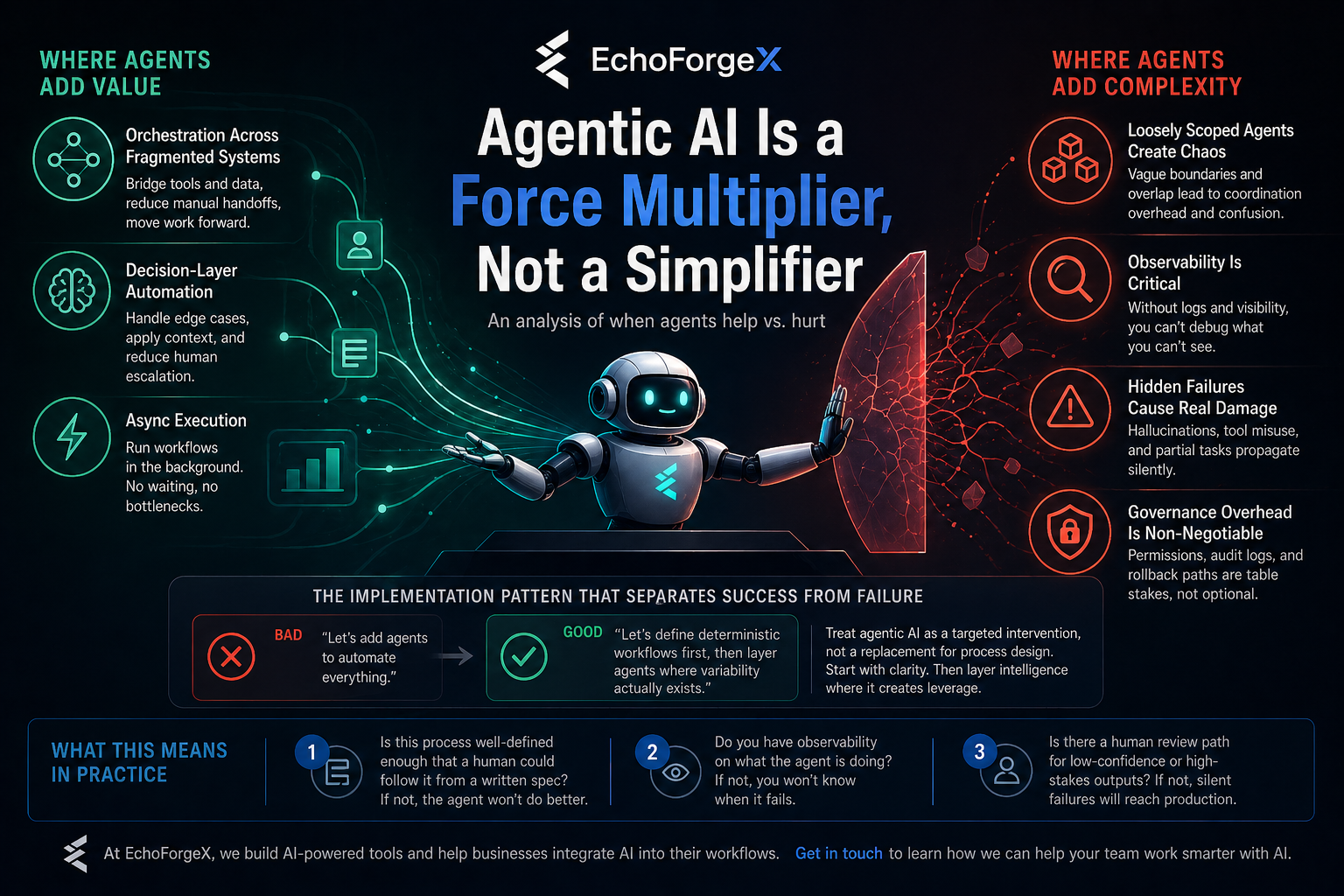
The honest description is this: **agentic AI is a force multiplier**. The direction of the force depends entirely on what you’re applying it to.
—
## Where Agents Actually Add Value
There are three areas where agentic AI delivers clear, measurable net value today.
### Orchestration Across Fragmented Systems
Most mid-size businesses run on a patchwork of tools—a CRM that doesn’t talk to the support platform, an ERP disconnected from the project tracker, internal dashboards that require manual data pulls. The integration tax on this is enormous: people spend significant chunks of their week just moving information between systems.
Agents are genuinely good at this. They can bridge CRM, support tools, billing systems, and internal dashboards, reducing manual handoffs without requiring a full re-platforming effort. The agent becomes the connective tissue that the API integrations were supposed to be but never quite achieved.
This works because the task structure is well-defined even if the systems aren’t: “pull this record, check that condition, update this field” is deterministic enough that an agent can execute it reliably.
### Decision-Layer Automation
Traditional rule-based automation breaks at the edges. Rigid `if/then` logic handles 80% of cases and collapses on the 20% that don’t fit the template. Human escalation fills the gap—but at volume, that becomes a bottleneck.
Agents handle edge cases better. Contract review, ticket triage, lead qualification—these are tasks where the inputs are variable and the decision criteria are contextual rather than strictly rule-based. An agent can reason about a non-standard contract clause, classify a support ticket that spans multiple categories, or qualify a lead that doesn’t match the usual firmographic profile.
The caveat is that these agents need guardrails: confidence thresholds, human review queues for low-confidence outputs, and clear escalation paths. The goal isn’t full automation—it’s reducing the human decision load to the genuinely hard cases.
### Async Execution
Knowledge work is heavily synchronous by default. A process stalls because someone is in a meeting, in a different timezone, or hasn’t checked their inbox. Agents break this dependency.
Background monitoring, triggered workflows, automatic resolution of routine tasks—these run without waiting on a human to be available. The compounding effect on throughput is significant, particularly for processes that involve multiple sequential steps across different systems.
—
## Where Agents Add Complexity
The failure modes are worth being specific about, because they’re not obvious until you’re already in them.
### Loosely Scoped Agents Create Microservices Chaos—With AI
The microservices era taught a painful lesson: decomposing a system into many small, independent components is only valuable if those components have clean interfaces and clear ownership. Without that, you end up with a distributed monolith—all the complexity of a large system with none of the benefits of simplicity.
The same pattern applies to agents. A proliferation of loosely scoped agents, each doing a slightly different thing with overlapping responsibilities and unclear handoffs, produces coordination overhead that dwarfs whatever efficiency was gained. Before adding agents, define their boundaries as precisely as you would define a service contract.
### Observability Becomes Critical and Non-Trivial
With traditional code, a bug has a stack trace. With an agent, a bad decision has a reasoning chain—and reasoning chains are harder to audit, harder to reproduce, and harder to attribute to a specific cause.
If you don’t build observability in from the start—logging inputs, outputs, tool calls, confidence scores, and decision paths—you will eventually have an agent making consequential decisions that you cannot explain or debug after the fact. This isn’t hypothetical; it’s the failure mode teams hit when they move fast on agent deployment without instrumentation.
### Hidden Failure Modes Don’t Surface Until Damage Is Done
Hallucinations, tool misuse, and partial task completion are particularly dangerous in agentic contexts because the agent often *appears* to have completed the task successfully. A downstream process picks up what it thinks is a valid output and continues. The error propagates silently until something breaks visibly—often far removed from the original failure.
The mitigation is validation at every step: check outputs before passing them downstream, build explicit failure states rather than relying on silent errors, and treat agent outputs with the same skepticism you’d apply to any external API.
### Governance Overhead Is Non-Negotiable
As soon as agents can take actions—sending emails, modifying records, making API calls on your behalf—you need to think about permissions, audit logs, and rollback mechanisms. These aren’t nice-to-haves; they’re the difference between an automated workflow and an automated liability.
This overhead is often underestimated because it’s invisible during development. It becomes very visible the first time an agent takes an action it shouldn’t have.
—
## The Implementation Pattern That Separates Success from Failure
The clearest way to frame the difference between implementations that work and those that don’t:
> **Bad:** “Let’s add agents to automate everything.”
> **Good:** “Let’s define deterministic workflows first, then layer agents where variability actually exists.”
The second approach treats agentic AI as a targeted intervention, not a general-purpose replacement for process design. It means doing the unglamorous work first—mapping existing workflows, identifying where the real variability and bottlenecks are, defining what “success” looks like for each step—and only then introducing agents in the places where that investment pays off.
This is counterintuitive because agents *feel* like they should abstract away the need for that work. They don’t. They require it.
The teams seeing the best results with agentic AI are the ones who treat it as an upgrade to an existing system, not a substitute for building one.
—
## The Question Worth Asking
The discussion question embedded in this analysis is a real one: where does agentic AI add the most net value today—decision-making layers or process orchestration?
The honest answer is that it depends on your current bottleneck. If your processes are reasonably well-structured but your decision volume is outpacing your team’s capacity, decision-layer automation delivers more immediate leverage. If your biggest cost is coordination overhead and manual handoffs across fragmented systems, orchestration wins.
In practice, the two aren’t mutually exclusive—well-instrumented orchestration pipelines create the conditions for reliable decision-layer automation. But starting with orchestration tends to produce more durable results, because it forces the process clarity that decision-layer agents require to function well.
—
## What This Means in Practice
Before adding agents to a workflow, ask three questions:
1. **Is this process well-defined enough that a human could follow it from a written spec?** If not, the agent won’t do better.
2. **Do you have observability on what the agent is doing?** If not, you won’t know when it fails.
3. **Is there a human review path for low-confidence or high-stakes outputs?** If not, silent failures will reach production.
Agentic AI is a genuine capability shift. The teams that will extract the most from it are the ones who treat it as infrastructure—something that requires design, instrumentation, and governance—rather than a feature you bolt on to an existing process.
At EchoForgeX, we build AI-powered tools and help businesses integrate AI into their workflows. Get in touch to learn how we can help your team work smarter with AI.