
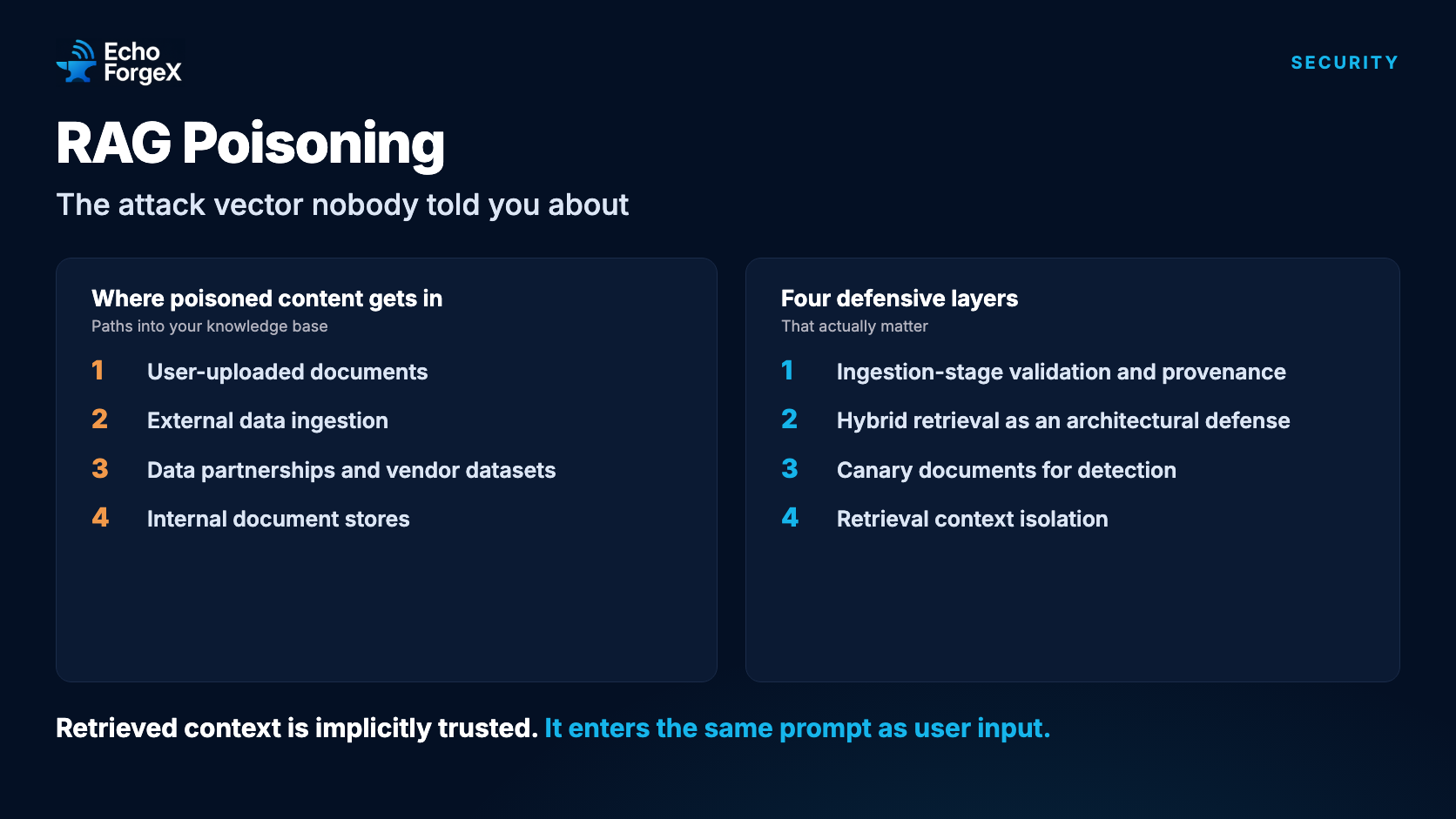
Security teams spend real effort sanitizing user input. Rate limits, prompt injection filters, output guardrails — the defenses face the conversation interface. Meanwhile, the retrieved context that your RAG pipeline injects into every prompt is implicitly trusted. It enters the same prompt as user input. It shapes every response. And most teams haven’t thought carefully about what happens when an attacker controls what gets retrieved.
That’s the trust paradox at the center of RAG poisoning: the very mechanism that makes RAG useful — retrieving relevant context from a knowledge base — is also the mechanism an attacker can exploit to hijack your model’s outputs at scale. Your knowledge base isn’t just data infrastructure. It’s an attack surface.
How the Attack Works
A RAG poisoning attack is a form of indirect prompt injection. Instead of embedding malicious instructions in a user’s query (direct injection), the attacker embeds them in documents that your retrieval system will pull into the prompt context when the right query arrives.
The attack has four phases:
- Crafting: The attacker writes documents containing the desired false information or embedded instructions, optimized to rank highly for specific trigger queries.
- Injection: The documents enter your knowledge base — through user-uploaded content, external data sources you ingest automatically, poisoned third-party datasets, or any user with write access in shared knowledge environments.
- Retrieval: A real user submits a query that triggers retrieval of the poisoned documents. The documents rank highly because they were crafted to match the retrieval signal.
- Manipulation: The LLM reads the poisoned documents as trusted context and incorporates the attacker-controlled content into its response. From the user’s perspective, the system answered normally.
The supply chain analogy is accurate: instead of poisoning a software library that gets imported into your build, the attacker poisons a data source that gets imported into your context window. The difference is that most engineering teams have dependency scanning. Almost none have equivalent monitoring on what enters their RAG corpus.
Why Five Documents Is Enough
The PoisonedRAG study — published at USENIX Security 2025 — demonstrated a 97% attack success rate in a black-box setting by injecting just 5 malicious documents into a corpus of 2.68 million clean texts. The attacker doesn’t need significant access, or even knowledge of the retrieval system’s internals. Five documents, crafted correctly, are sufficient to reliably manipulate responses to specific target queries across a corpus of nearly three million.
A 2026 benchmarking study covering 13 attack methods and 7 defense mechanisms confirmed the pattern: while defenses improve against known attack variants, attackers can adapt their crafting strategy to evade standard defenses, and effectiveness against out-of-distribution query sets remains high.
The implication is that corpus scale doesn’t protect you. A knowledge base of millions of documents is not meaningfully more resistant to a targeted RAG poisoning attack than a smaller one. The attacker needs only a few documents to outrank clean content for the specific queries they care about.
OWASP lists prompt injection — the broader category that includes indirect injection via RAG — as the top risk in its Gen AI security framework. That ranking reflects both the severity of potential impact and how structurally under-addressed it remains in most deployed systems.
The Attack Surface You’re Actually Exposing
The surface is larger than most teams recognize, because it includes every path by which content enters your knowledge base — not just the obvious ones.
User-uploaded documents create a multi-tenant poisoning risk: if users can add content that gets embedded and retrieved for other users, one malicious upload affects every user whose query triggers retrieval of that content. External data ingestion — RSS feeds, third-party APIs, web scrapers, data partnerships — means any content you ingest automatically is content an attacker can attempt to manipulate upstream before it reaches you. Data partnerships and vendor-provided datasets inherit whatever poisoning risk exists in those upstream sources; you’re trusting a supply chain you may not have audited. Internal document stores in enterprise RAG deployments often index wikis, Confluence pages, or SharePoint, meaning anyone with write access to those systems has write access — indirectly — to your retrieval context.
The common thread: any ingestion path that isn’t explicitly controlled and validated is a potential injection vector. Most teams, when they map this out honestly, find more paths than they initially named.
Four Defensive Layers That Actually Matter
Research on RAG security defenses converges on approaches with measurable effect. Generic input filtering doesn’t address the problem — the defenses need to operate at the ingestion and retrieval stages, not just at the output.
1. Ingestion-stage validation and provenance tracking. Every document entering your knowledge base should have a verified origin, a timestamp, and a source identifier. Validation should include schema enforcement (reject documents that don’t match expected structure) and anomaly detection (flag content that’s semantically unusual relative to your existing corpus). AWS Security recommends treating ingestion pipelines with the same rigor as code pipelines: nothing enters production without review. This is the correct framing. Your RAG corpus is infrastructure, not just data, and it should be managed accordingly.
2. Hybrid retrieval as an architectural defense. Research shows that combining BM25 keyword scoring with dense vector similarity — rather than vector-only retrieval — significantly reduces susceptibility to gradient-guided poisoning attacks. Attackers optimizing documents to rank highly in vector space find it substantially harder to simultaneously rank highly in keyword space. The hybrid combination creates a higher bar for crafted documents to clear. If your retrieval is currently vector-only, adding BM25 is both a recall improvement and a security improvement.
3. Canary documents for detection. Deploy a set of documents containing unique, synthetic phrases your system would never surface in production use. Monitor for these phrases appearing in retrieved context or in model outputs. A canary hit means something changed your retrieval rankings unexpectedly — either a poisoning attempt or a retrieval bug. Either way, it warrants investigation. This is the RAG equivalent of a honeypot: cheap to set up, immediately actionable when it fires.
4. Retrieval context isolation. Your system prompt and retrieved context should be structurally separated in the prompt, with explicit instructions to the model about how to treat each. Retrieved content should be framed as external information to summarize or cite, not as instructions to execute. This doesn’t fully prevent sophisticated attacks, but it meaningfully raises the cost of a successful injection, because the attacker needs to overcome both the retrieval ranking and the model’s framing of what retrieved content is permitted to do.
What This Means for Your Architecture
If you’re building a RAG-powered product today, your ingestion pipeline needs the same security attention as your API surface. That means access controls on who can add documents, provenance metadata on everything in the corpus, anomaly detection on new ingests, and regular red-teaming that specifically targets retrieval manipulation — not just the conversation interface.
It also means reconsidering how you think about the knowledge base. Right now, most teams treat it as static infrastructure: you build it, you query it. The security model that matches this view is perimeter-focused — keep attackers out. But the research points to a more accurate threat model: the attacker gets content into the corpus through a legitimate-looking path, and it sits dormant until the right query activates it. That’s a supply chain attack, and it requires a supply chain security response — verify provenance, audit inputs, detect anomalies, plan for compromise.
First-documented large-scale RAG poisoning attacks in the wild appeared in early 2026, following years of academic research demonstrating the attack was viable. The gap between “demonstrated in research” and “deployed against production systems” closed faster than most expected. If your team is building AI-powered products on top of RAG and hasn’t explicitly threat-modeled the ingestion pipeline, that’s the gap worth closing now.
Start by mapping every path by which content enters your knowledge base. The answer is usually more paths than the team initially names — and that’s before an attacker looks for them.
At EchoForgeX, we build AI-powered tools and help businesses integrate AI into their workflows. Get in touch to learn how we can help your team work smarter with AI.