
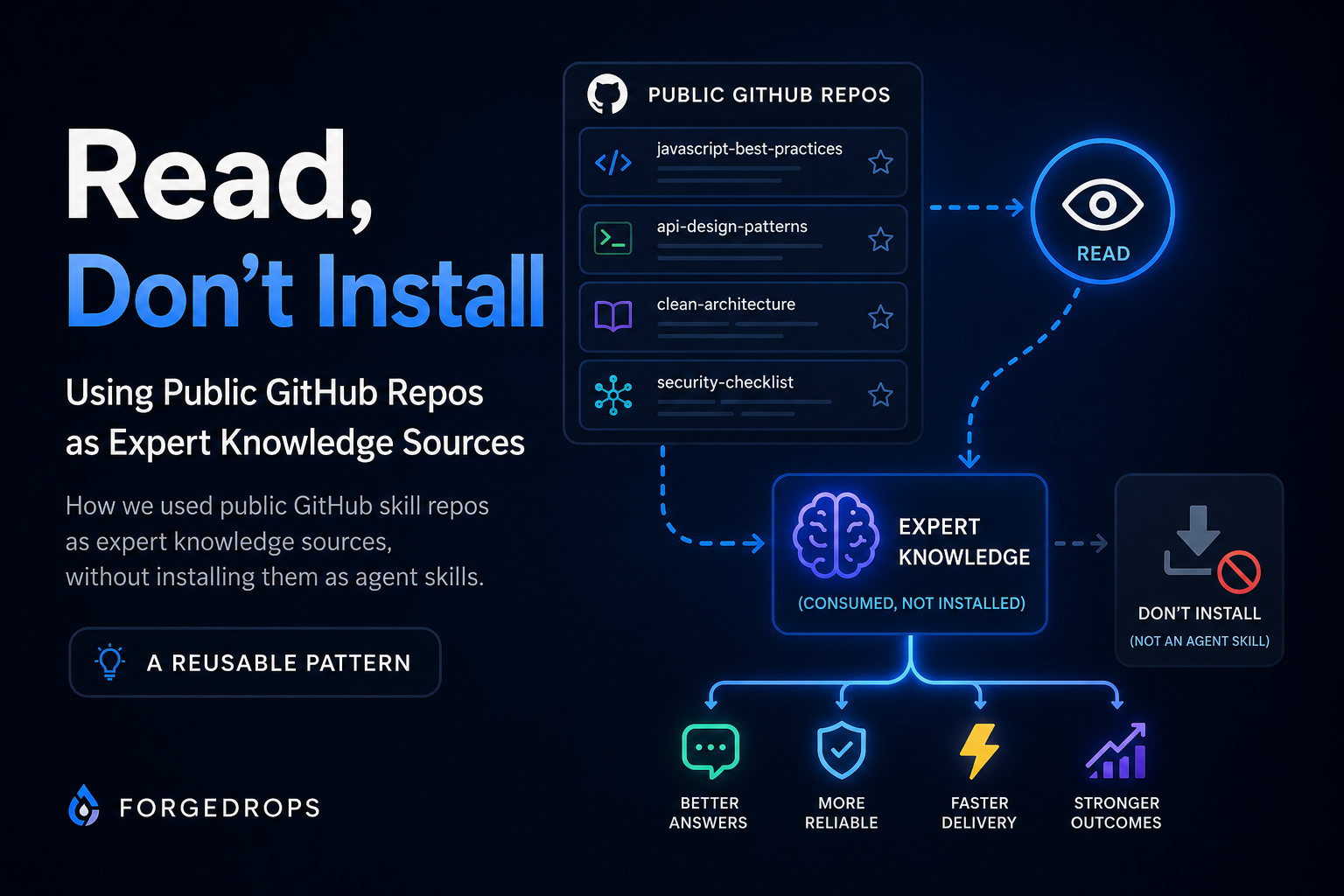
There are now over 13,590 public repositories built specifically as AI agent skill collections. These repos package structured domain knowledge for harnesses like Claude Code, Codex, and Cursor, and the assumption baked into all of them is the same: install the skills and invoke them from within the harness they were designed for.
We did something different. We pointed an agent at a repo and asked a single question: “What in here is useful for our codebase?” What came back was not a list of commands to register. It was a structured, prioritized implementation backlog sourced from practitioners who had already done the hard work of systematizing their expertise.
No harness configuration. No skill installation. Just the knowledge, applied to our specific product.
The Problem We Were Trying to Solve
ForgeDrops publishes a packaged business idea every Monday for solo founders: each drop is free to browse, and the full depth document, implementation guide and project brief are sold as a one-time package. When we shifted focus to growth, we hit a problem that every early-stage product team eventually faces: the disciplines that matter most for traction require expertise that is expensive, hard to hire for, and slower to develop in-house than the business can wait for.
We needed someone who understood SEO for AI-powered search tools like Perplexity. Someone who had audited signup flows for friction. Someone who had thought through paywall copy and CTA hierarchy on gated content pages. Getting all three at once, with any depth, was not realistic.
What we found was that people with that depth had already written it down. Not as blog posts or consulting decks, but as structured GitHub repos built to run inside AI agent harnesses.
What Is Actually Inside These Repos
The two repos we worked with were coreyhaines31/marketingskills and phuryn/pm-skills. Both are organized as collections of named skill files, one per discipline, covering areas like conversion rate optimization, onboarding, content strategy, AI search optimization, and paywall design.
The authors built these for invocation within an agent harness. We were not interested in the invocation layer. We were interested in the knowledge inside: the frameworks, the checklists, the prioritized recommendations that an experienced practitioner had encoded into structured Markdown.
When you step back from the harness framing, these repos look less like software packages and more like structured domain reference material. The kind a senior consultant would bring to a first engagement, already organized and ready to apply against a real product. Using GitHub repos as AI knowledge sources, rather than installed components, is a subtle reframe with a significant practical difference.
The Technique: Point, Ask, Synthesize
The workflow is simple enough to describe in a sentence: give the agent a repo URL and ask what applies to your product.
We ran this with Claude Code pointed at the marketingskills repo and asked: “What in this repo can be useful to apply to our ForgeDrops codebase?” The agent read the skill files, matched each discipline against what it knew about ForgeDrops, and returned a structured breakdown organized by priority and relevance.
No installation step. No configuration. The repo’s structured knowledge transferred through the agent’s ability to read, reason, and synthesize.
The prompt can be narrowed to match your specific situation:
- “Which of these skills apply to our current conversion funnel?”
- “Which items address gaps we currently have versus areas we have already covered?”
- “Rank these by expected impact given our current stage and traffic levels.”
The synthesis is where the value accumulates. The agent does not just summarize repo contents. It maps each discipline to your specific product, filters by relevance, and surfaces what you would otherwise need a specialist to identify through a proper audit.
What We Got Out of It
From the marketingskills repo alone, we generated a structured implementation backlog spanning eight disciplines. Two shipped within the first week.
From the ai-seo skill file: we deployed an llms.txt, a machine-readable /pricing.md route, and a sitemap index to production. That gives LLM-powered search tools such as Perplexity and ChatGPT browsing machine-readable content to read, alongside the pages written for people.
From the product-marketing skill file: we built a foundational context document covering three buyer personas, pain-point language, competitive positioning, and brand voice rules. This document now serves as the shared context layer that every future copy pass, CRO audit, and campaign brief reads before starting work. Without it, each new effort reinvents the same baseline from scratch.
Eight more items are queued across conversion, content, and retention. Each task in the backlog is tagged back to the specific skill file that sourced it. That tagging keeps the work grounded in the framework rather than accumulating as ad hoc additions from whoever raised their hand last week.
That structure matters more than it might seem. Marketing work at early-stage products tends to drift without a clear source of priority. A named, sequenced backlog tied to a practitioner framework gives the work discipline and makes it straightforward to evaluate scope changes against an explicit reference.
Why This Works
Skill repos are written to be machine-readable by design. Authors structure their knowledge for agent consumption: named concepts, explicit scope, referenced frameworks, and a clear priority order. That same structure makes them excellent material for an agent reasoning over your specific product context.
The knowledge transfer does not depend on the installation mechanism. Whether expertise arrives via a /skill invoke command or via an agent reading a directory of Markdown files and synthesizing the applicable parts, the output is the same: domain context applied to your specific situation.
What changes is the integration overhead. Installing and maintaining a skill requires harness compatibility checks, versioning, and configuration management. Pointing an agent at a repo and asking the right question requires a URL. For a team that needs domain expertise without committing to a specific toolchain, that difference is significant.
How to Apply This Pattern
The approach applies to any domain where practitioners have encoded structured expertise into a GitHub repo. The skill repo ecosystem now spans engineering practices, product management, compliance, finance, legal operations, and marketing. Most of it is publicly available. Most teams looking at these repos as software packages to install are walking past an equally valid use: curated reference material for a reasoning agent.
Give the agent your specific context. “What is useful for our product” returns better output than “summarize this repo.” Include your product’s current state, your growth stage, and the specific gaps you already know you have. The synthesis quality scales with how well the agent understands what you are trying to solve.
Ask for prioritization, not just relevance. The raw list of applicable skills is not a roadmap. Ask the agent to rank by expected impact given your stage, your current coverage, and your team’s near-term capacity. This converts a survey into a sequenced queue.
Track the source in your backlog. When tasks come out of this synthesis, tag them with the skill file that generated them. This keeps the backlog grounded and makes it straightforward to revisit the original source when scope or priorities shift.
Revisit repos as the product matures. A repo that produced Tier 1 SEO work early on may surface relevant items in a different discipline six months later, once the baseline is covered and a different constraint becomes the priority.
This is one of the patterns that informs how we approach AI integration work at EchoForgeX: not every AI capability needs to be installed and maintained as infrastructure. Sometimes the most direct path is a well-formed question pointed at the right source.
The Broader Takeaway
The framing of skill repos as installed software components creates a mental model where their value is contingent on whether you are using the right harness. If the repo was built for Claude Code and you are not running Claude Code sessions, the knowledge appears out of reach.
It is not. Using GitHub repos as AI knowledge sources works because structured domain expertise in a readable format is accessible to any agent capable of reading and reasoning. The harness is optional. The knowledge is not.
As more practitioners across more disciplines encode their expertise into agent-ready repos, the volume of publicly available, structured domain knowledge available this way will keep growing. You do not need a skill management pipeline to benefit from it. You need a URL and the right question.
At EchoForgeX, we build AI-powered tools and help businesses integrate AI into their workflows. Get in touch to learn how we can help your team work smarter with AI.